How to Build an Effective AML Framework: Risk Assessment, Controls and Governance

An effective anti-money laundering (AML) framework should not be built solely around standard procedures or formal checks. It should start with the risks to which the organization is exposed and translate the assessment of those risks into concrete, proportionate and verifiable measures.
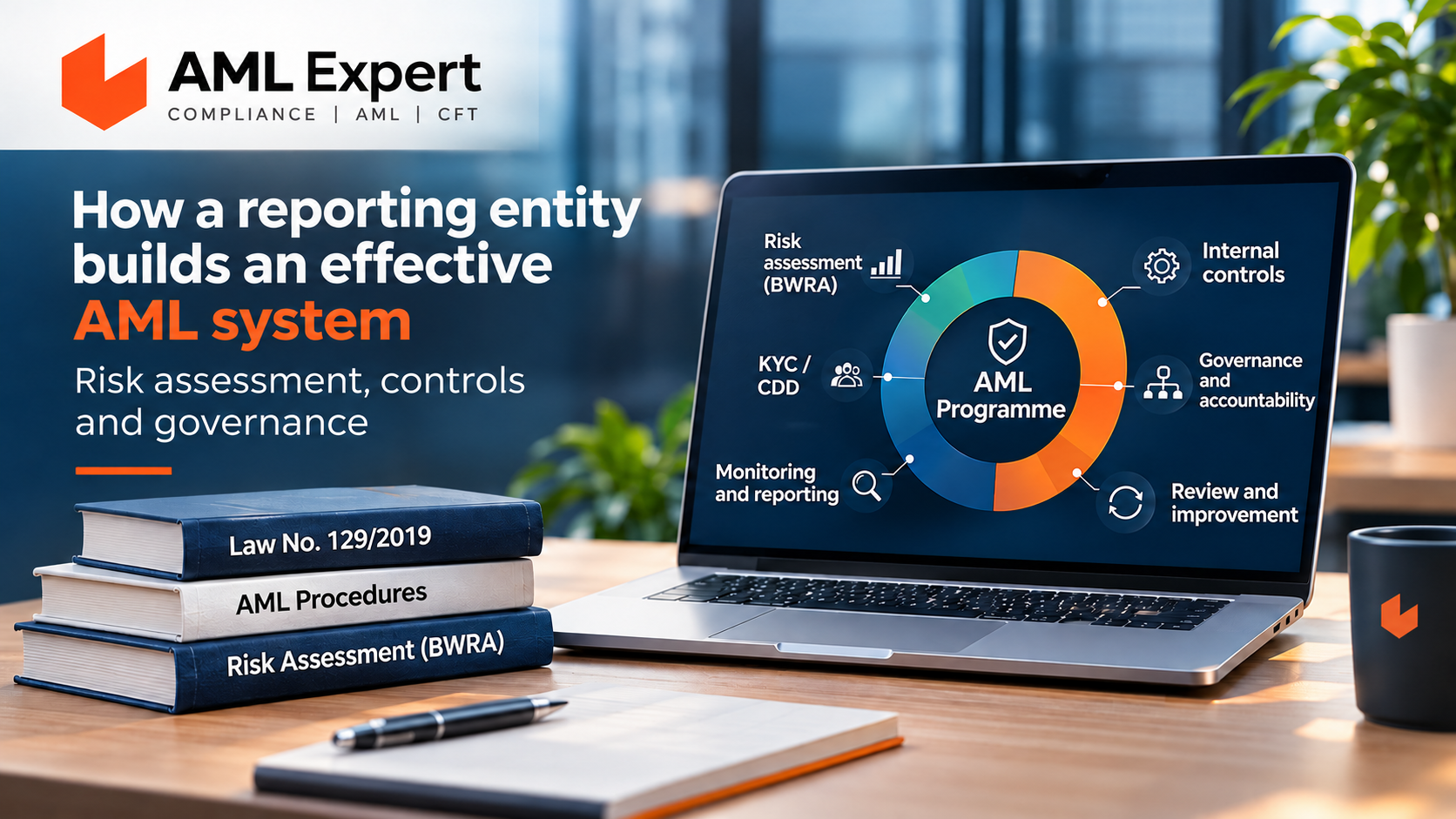
This approach is relevant to all categories of obliged entities, from financial institutions and entities supervised by the National Bank of Romania (NBR) or the Financial Supervisory Authority (ASF) to designated non-financial businesses and professions. Sector-specific requirements may differ, but the logic of a coherent AML framework remains the same: identify risks, establish controls, apply them consistently and assess their effectiveness.
1. The risk-based approach: the starting point of an AML framework
The risk-based approach requires prevention measures and resources to be proportionate to the risks identified. An organization must understand where it may be exposed to money laundering or terrorist financing, how significant that exposure is, and which measures are needed to mitigate it.
In practice, this means that not all business relationships, products, services or transactions should be treated in the same way. A customer with a complex ownership structure, activity that is difficult to explain, or links to high-risk jurisdictions may require additional measures compared with a customer whose profile is straightforward and whose activity is predictable.
The risk-based approach does not mean arbitrarily reducing checks. It means justifying the level of due diligence and monitoring by reference to the specific risks of the relationship or activity.
2. Entity-wide risk assessment
An entity-wide risk assessment — often referred to as a Business-Wide Risk Assessment (BWRA) — provides an overall view of the organization’s exposure. It should reflect how the entity actually operates, rather than simply reproduce a generic list of risks from a template.
A useful assessment examines at least the following dimensions, tailored to the entity’s profile and activities:
Customers and beneficial owners: customer types, ownership and control structures, business profiles and business relationships.
Geography: the countries where customers, beneficial owners and business partners are located, or where activities are carried out.
Products and services: the nature and complexity of the services offered and the extent to which they could be misused for money laundering or terrorist financing.
Delivery and interaction channels: remote relationships, intermediaries, agents, introducers and other ways of accessing services.
Technology and controls: the tools used for identification, verification, screening, monitoring and record-keeping.
The assessment should take account of the organization’s data and experience: its actual customer portfolio, the types of services provided, incidents and alerts encountered, control results, identified deficiencies and changes in the operating environment.
3. Inherent risk, control effectiveness and residual risk
To avoid a superficial assessment, three elements should be considered separately:
Inherent risk — the level of exposure before taking the organization’s controls into account.
Control effectiveness — the extent to which policies, procedures, checks and systems actually reduce the identified exposure.
Residual risk — the level of risk that remains after assessing the existing controls.
A high inherent risk does not automatically become a low residual risk simply because a written procedure exists. The organization must be able to demonstrate that measures have been implemented, applied by the responsible personnel and tested periodically. If checks are not performed or no evidence exists, control effectiveness cannot be assumed.
The assessment must therefore be supported by clear criteria, documented rationale and verifiable evidence. Risk scores or ratings are useful only when the outcome can be explained and translated into operational measures.
4. From entity-wide assessment to individual customer risk
The entity-wide assessment does not replace the individual customer risk assessment. The two levels must work together.
The entity-wide assessment identifies the main sources of exposure and establishes the control framework. The Customer Risk Assessment (CRA) applies this perspective to a specific relationship, taking into account the customer’s identity, beneficial owner, purpose and intended nature of the relationship, expected activity and other relevant factors.
The outcome of the customer assessment should influence customer due diligence measures and the level of monitoring. A customer classified as high risk may require additional checks, appropriate senior-level approval and closer monitoring, depending on the applicable legal framework and the entity’s procedures.
The connection between the organization’s risk assessment, customer risk assessment and ongoing monitoring should therefore be visible and documented. If these processes operate separately without informing one another, the AML framework becomes fragmented.
5. Governance and responsibilities
An effective AML framework is not the sole responsibility of the designated officer or compliance department. Management must provide the necessary resources, approve the policy framework and oversee whether significant risks are being managed appropriately.
Depending on the organization’s size and complexity, responsibilities may be organized around the three lines of defence model:
First line — operational teams that interact with customers and apply controls in day-to-day activities.
Second line — the compliance and AML function, which establishes or coordinates the control framework, provides guidance and monitors compliance with requirements.
Third line — internal audit or an independent assurance function, which assesses whether the framework is properly designed and operating effectively.
The model should be adapted to the entity’s size and structure. Responsibilities must be clear, conflicts of roles must be managed, and deficiencies must be escalated to the level of management able to decide on corrective action.
6. Documentation and evidence: what the entity must be able to demonstrate
An AML framework cannot be assessed solely by checking whether documents exist. The entity must be able to demonstrate that the documented processes are applied in practice and that decisions are traceable.
Depending on the activity and applicable requirements, the evidence file may include:
the risk assessment methodology and the actual assessment, dated and approved;
the rationale for risk factors, weightings and assigned risk ratings;
the AML policies and procedures in force, together with their version history;
records of checks performed, alerts reviewed and decisions made;
testing and control reports, audit findings and remediation measures;
evidence of staff training and communication of responsibilities.
The methodology and the actual assessment are not the same thing. The methodology explains how the organization assesses risks. The actual assessment shows which risks were identified on a particular date, based on the information available at that time, and which measures were established.
7. Reviewing the assessment and monitoring indicators
The risk assessment must remain relevant. Periodic reviews, scheduled according to the entity’s risk profile and applicable sector-specific requirements, help identify changes. Reassessment is also important when significant changes occur, such as new products or services, geographic expansion, changes in the customer portfolio, relevant incidents or control deficiencies.
Monitoring indicators can help management and the AML function assess whether the framework is working. Examples of useful indicators, tailored to the entity’s activities, include:
the number and proportion of high-risk customers;
incomplete KYC files or files requiring an update;
unidentified beneficial owners or insufficiently documented ownership and control chains;
outstanding alerts and their age;
screening and monitoring coverage;
outstanding remediation actions following controls or audits.
Indicators should not be tracked for reporting purposes alone. They should trigger root-cause analysis and, where necessary, concrete action: reviewing procedures, increasing resources, improving data or recalibrating controls.
8. What is changing at European level
The EU AML framework is undergoing reform. Regulation (EU) 2024/1624 — the Anti-Money Laundering Regulation (AMLR) — is generally set to apply from 10 July 2027, although certain provisions may have different timelines. Directive (EU) 2024/1640 establishes the framework for transposing elements of the new system, while Regulation (EU) 2024/1620 establishes the Authority for Anti-Money Laundering and Countering the Financing of Terrorism (AMLA).
AMLA will have coordination and supervisory responsibilities at EU level, including direct supervision of a selected number of entities in the financial sector. This does not mean that all obliged entities will be directly supervised by AMLA. Entities should monitor the legislation applicable to their own sector and the relevant implementation timetable.
9. Checklist: questions to assess your AML framework
Does the risk assessment reflect the entity’s actual activities and customer portfolio?
Are inherent risk, control effectiveness and residual risk assessed separately?
Is there a clear link between the entity-wide assessment, customer risk assessment and ongoing monitoring?
Are the responsibilities of management, the AML function and operational teams documented?
Can the entity demonstrate that procedures are applied, not merely approved?
Are there indicators showing whether control measures are working?
Is the assessment reviewed when relevant changes occur?
Conclusion
An effective AML framework is not a collection of documents, but an integrated mechanism for identifying, assessing and managing risks. The entity-wide assessment should inform customer assessments, customer due diligence measures and ongoing monitoring. Governance, documentation and control testing make it possible to demonstrate that the framework is effective.
For an obliged entity, the key question is not simply whether it has an AML procedure, but whether it can explain why it selected particular controls, how it applies them and what evidence shows that they reduce the identified risks.
Frequently asked questions
What is an entity-wide AML risk assessment?
It is the process through which an organization identifies and assesses its exposure to money laundering and terrorist financing risks, considering customers, geography, products and services, delivery channels and the effectiveness of controls.
What is the difference between BWRA and CRA?
BWRA addresses the organization’s overall exposure. CRA addresses the risk associated with a specific customer or business relationship. The customer assessment should be consistent with the risks and criteria identified at entity level.
Is having an approved AML procedure sufficient?
No. The entity must be able to demonstrate that the procedure is implemented, applied by the responsible personnel, monitored and reviewed when necessary.
Must all obliged entities use the same methodology?
No. The framework must be tailored to the nature, size and complexity of the activity, the entity’s own risks and applicable sector-specific requirements. There is no single matrix suitable for every type of entity.
How often should the risk assessment be reviewed?
The frequency should be determined in line with applicable legal and sector-specific requirements and the entity’s risk profile. The assessment should also be revisited whenever significant changes occur that could affect its outcome.
Resources and legislative references
For practical application, always check the latest consolidated version of the legislation and the requirements of the competent authority for your sector. The following are primary sources for reference:
This article is for informational purposes only and does not replace a legal assessment of the obligations applicable to a specific entity. Requirements may vary depending on the sector, supervisory authority and activity carried out.
Need support assessing and structuring your AML framework?
AML Expert provides consultancy and support services to obliged entities in Romania, including risk assessments, procedures and compliance measures tailored to their activities. Explore our services and check whether your activity falls within the scope of obliged entities.


Comments